Information: This is an old - not maintained - article of the AEIOU. In the Austria-Forum you find an updated version of this article in the new AEIOU.
Entdeckungen und Forschungsreisen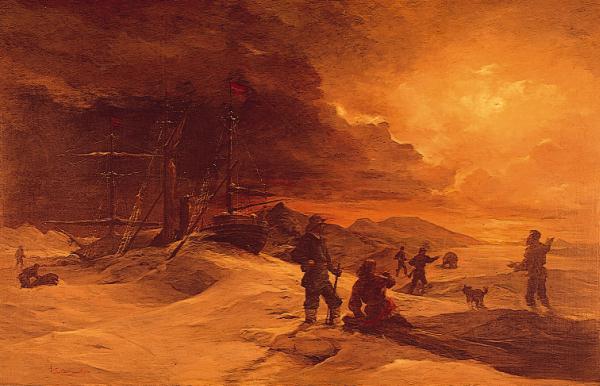
© Copyright Discoveries: in the pack ice of the Arctic. Painting by Julius von Payer, 1874 (Museum of Military History, Vienna). Discoveries and Explorations: many Austrians have made important contributions to the exploration of the earth and the enrichment of knowledge about peoples and cultures unknown to Europeans. During the Austro-Hungarian monarchy even naval expeditions were undertaken, such as the world voyage of the frigate "Novara" (1857-1859, Novara Expedition) organised by the Austrian navy. Its exploration of the oceans, especially the South Pacific, and research into maritime meteorology were an important stimulus to oceanographic research. In 1870 the Arctic explorer J. Payer discovered Franz Josef Fjord in north-east Greenland. Together with K. Weyprecht he reached Franz Josef Land (Zemlya Frantsa-Iosifa) in the North Arctic Ocean during an Austro-Hungarian expedition to the North Pole (Austro-Hungarian North Pole Expedition). Weyprecht proposed the introduction of international polar years and thus founded the systematic exploration of the polar regions. A. Wegener continued this tradition, carrying out extensive studies in Greenland. Many areas as yet unknown to Europeans were put on the map by Austrian explorers in the course of difficult and dangerous journeys. Around 1850 Ida Pfeiffer made 3 world voyages all on her own and came to regions no European had set yet foot on. Sprenger In 1888 Count Teleki and L. von Höhnel were the first Europeans to reach Lake Rudolf and Lake Stephanie in East Africa. O. In 1892/93 O. Baumann, who was only 28 years old at that time, reached the source of the River Nile (as the source of the Kagera), which Europeans had been trying to find for many years. Mount Hochstetter (F. v. Hochstetter) in New Zealand and Cape Bauer (F. L. Bauer) in southern Australia are named after Austrian explorers. Numerous Austrians set out to explore the high mountains of the world (Himalaya, Karakoram, Caucasus, Andes and the summits of East Africa). H. Harrer stayed in Tibet for 7 years, H. Tichy walked through vast regions of the Himalaya mountains. In their popular books, they made the "roof of the world" known to a large public. Austrian ethnologists (ethnology) have contributed extensively to the documentation and exploration of cultures unknown to Europeans. As early as the 17th and 18th centuries, Austrian missionaries reported on the life of peoples in regions which were then in the Spanish colonies (South America, Philippines etc.). They learned the language of the indigenous peoples and recorded their way of life. In the 20th century the order Societas Verbi Divini (Missionshaus St. Gabriel) sent out missionaries who were also trained ethnologists. M. Gusinde described the way of life and religious beliefs of the inhabitants of Tierra del Fuego, P. Schebesta studied and lived with pigmy tribes in Africa and South-East Asia. Scientific research interests took Etta Becker-Donner, a woman travelling alone, to unknown cultures in Africa and to the Indians in inner regions of Brazil. R. von Heine-Geldern, an expert on South-East Asia, found evidence of cultural similarities amongst the peoples of the world. René de Nebesky-Wojkowitz provided the basis for the exploration of Tibetan mountain cults in the Himalayas. Numerous Austrian travellers and explorers helped complete the picture of the earth and its inhabitants. Literature: H. Hassinger, Österreichs Anteil an der Erforschung der Erde, 1949; O. Marschalek, Ö. Forscher, 1949. References to other albums:
| |||||||||||||||||||||||||||||||||||||