Information: This is an old - not maintained - article of the AEIOU. In the Austria-Forum you find an updated version of this article in the new AEIOU.
Enns, Fluss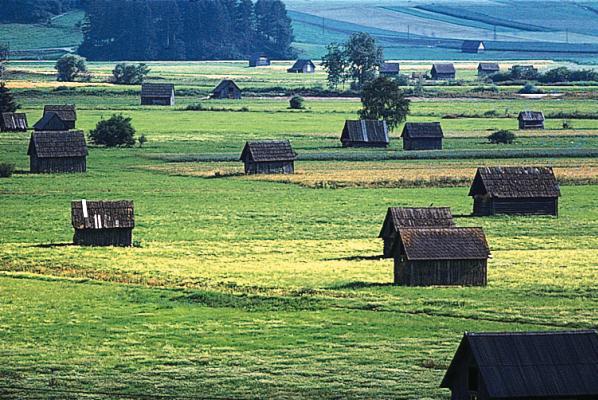
© Copyright Ennstal valley: haystack stands near Irdning. Enns, River, southern tributary of the River Danube, main river in north-western Styria; its name derives from Celtic "Anisa", 254 km long; a typical torrent of the northern part of the Eastern Alps, it has the fifth largest catchment area in Austria (6,080 km2). Its average rate of flow at the measuring point Enns-Ortskai is 201 m3/sec. The River Enns has its source in the Radstädter Tauern mountains in the province of Salzburg and flows through a partly marshy, longitudinal valley, which was formed during the Ice Age, between the northern Limestone Alps and the Central Alps; until it meets the River Palten; at the Mandling pass it enters the province of Styria and cuts through the limestone massif Ennstal Alps, forming the narrow, 15 km long Gesäuse valley between Admont and Hieflau. It then turns north and after being joined by Laußabach stream flows on Upper Austrian territory. North of the town of Steyr, in the Alpine Fore-Land, the River Enns forms the border between the provinces of Upper and Lower Austria, (hence the old names "Österreich ob der Enns" - i.e. above the Enns, and "Österreich unter der Enns" - i.e. below the Enns), and flows into the River Danube near Mauthausen. In the middle of the 19th century the regulation of the approximately 70 km-long stretch between Weißenbach bei Haus and the Gesäuse was undertaken, the aim being to gain effective areas for agriculture and forestation by draining the valley bottoms. By 1939 the course of the river had been shortened by 19 km. The Ennskraftwerke-AG (Ennskraft) built 10 run-of-river power plants (Schönau, Weyer, Großraming, Losenstein, Ternberg, Rosenau, Garsten-St. Ulrich, Staning, Mühlrading and St. Pantaleon) in the lower course of the E. valley. In 1998 these 10 storage power plants generated a total wattage of 1.8 billion kWh. The main towns and villages of the E. valley are: Radstadt in the province of Salzburg; Schladming, Gröbming, Liezen, Selzthal and Admont in Styria; Großraming, Ternberg, Garsten, Steyr and Enns in Upper Austria. Today the Ennstal valley is a major transit road between Germany and Slovenia. References to other albums:
| |||||||||||||||||||||||||||||||||||||